Mobile Kitchen Packaging Operations
Food Truck Packaging: Space, Speed & Event Stock Buyer Guide
A food truck carries its kitchen, stockroom and service counter in one small footprint. Packaging must fit the menu and food, but it must also fit the shelves, working bundles, event forecast, rapid handoff and replenishment plan.
Why food truck packaging needs its own plan
A fixed restaurant can hold several cases in a storeroom and move reserve stock to the line. A food truck, trailer, cart or temporary stall has limited shelves, narrow working surfaces and a changing route. Every extra box size competes with ingredients, equipment and staff movement.
The buyer therefore needs more than a material comparison. The specification must connect menu fit, service speed, units per shelf, event demand, restocking and wholesale supply. A package that performs well but blocks the aisle or runs out mid-event is not operationally suitable.
Define the mobile service model
Record whether the business operates from a truck, trailer, cart, pop-up tent or shared event booth. Note the normal number of staff, prep location, service windows, travel between sites, available dry storage and whether reserve cases stay in a support vehicle or commissary.
Separate street service, private catering, festivals and corporate events. Each has different order concentration, menu limits, carrying distance and replenishment access. Build packaging quantities and workstation rules for each service model rather than using one average day.
Create a menu-to-package matrix
List every sellable item, portion, temperature, grease or moisture profile, side, sauce, drink and customer handoff. Assign a primary package and an approved alternative. Include napkins, cutlery, labels and carry bags that are consumed with the order.
The matrix reveals duplicate formats and hidden components. Two boxes with nearly identical dimensions may be consolidated after testing, while a wet meal and a dry snack may need separate constructions despite similar footprints.
Reduce packaging SKU count deliberately
Fewer SKUs simplify stocking, staff training and event loading, but excessive consolidation can create waste or food damage. Score each possible common format against menu fit, portion presentation, grease, closure, customer handling and cost.
Keep a separate item when the failure risk or operating benefit is meaningful. Use clear item codes, size marks or color cues so staff can identify the right package before filling it during a rush.
Map the packaging workstation
Draw the packaging flow from finished food to handoff. Mark where empty units, wraps, bags, labels and condiments sit; which hand reaches them; where assembly occurs; and where completed orders wait. Measure the usable width, depth and height of every shelf and dispenser.
A package should not force staff to cross hot equipment, turn around repeatedly or build cartons over uncovered food. Simulate the busiest menu combination and redesign the position before ordering cases that do not fit the intended station.
Measure working stock and reserve stock separately
Working stock is the quantity accessible during service without opening a case or leaving the station. Reserve stock is the sealed backup available in the truck, support vehicle, venue or commissary. Define both for each SKU and state who replenishes the station.
Small bundles can be easier to load into narrow cabinets than a whole carton. Request inner-pack dimensions and counts, not only master-carton data. Protect reserve packaging from splash, grease, floor contact, pests and crushing.
Compare flat, nested and pre-erected formats
| Supply format | Mobile-kitchen advantage | Operational cost to test |
|---|---|---|
| Flat folding cartons | High unit count per shelf and efficient master cartons | Assembly time, wrong folds, tab damage and counter space |
| Nested clamshells | Fast pick-and-fill with a formed cavity and closure | Stack height, denesting, rim damage and carton cube |
| Open paper trays | Quick service and easy eating for immediate handoff | Liner, carrying distance, wind, spills and need for an outer bag |
| Wraps or sheets | Very compact storage and flexible menu use | Wrapping skill, grease, steam, labels and order identification |
Calculate usable units per shelf
Case pack alone does not describe space efficiency. Measure the bundle dimensions in the orientation used on the truck, then calculate units that fit without compression or blocking a door. Include clearance for hands and for the package to open or denest.
Compare usable units per shelf, per cabinet and per event load. A lower-priced format may require more storage or more frequent restocking, while an ultra-compact stack can be slow to separate.
Test denesting and assembly during a rush
Time staff selecting, opening, filling, closing and handing off each candidate. Record double picks, stuck units, damaged rims, wrong folds, released locks and packages dropped because they require two careful hands.
Run the test with normal gloves, realistic heat, noise and order tickets. A calm sample demonstration does not predict peak service. Use median time and error rate rather than a single fastest attempt.
Build a peak-throughput target
Estimate orders per five or fifteen minutes at the busiest expected window. Convert the menu mix into packaging actions and identify the slowest repeated step. Packaging should support the target without causing completed food to wait unnecessarily.
Consider pre-erecting a limited quantity before opening, but control contamination, space and unused units. The plan should state maximum staged quantity, storage position and the point at which staff assemble more.
Choose burger boxes for compact service
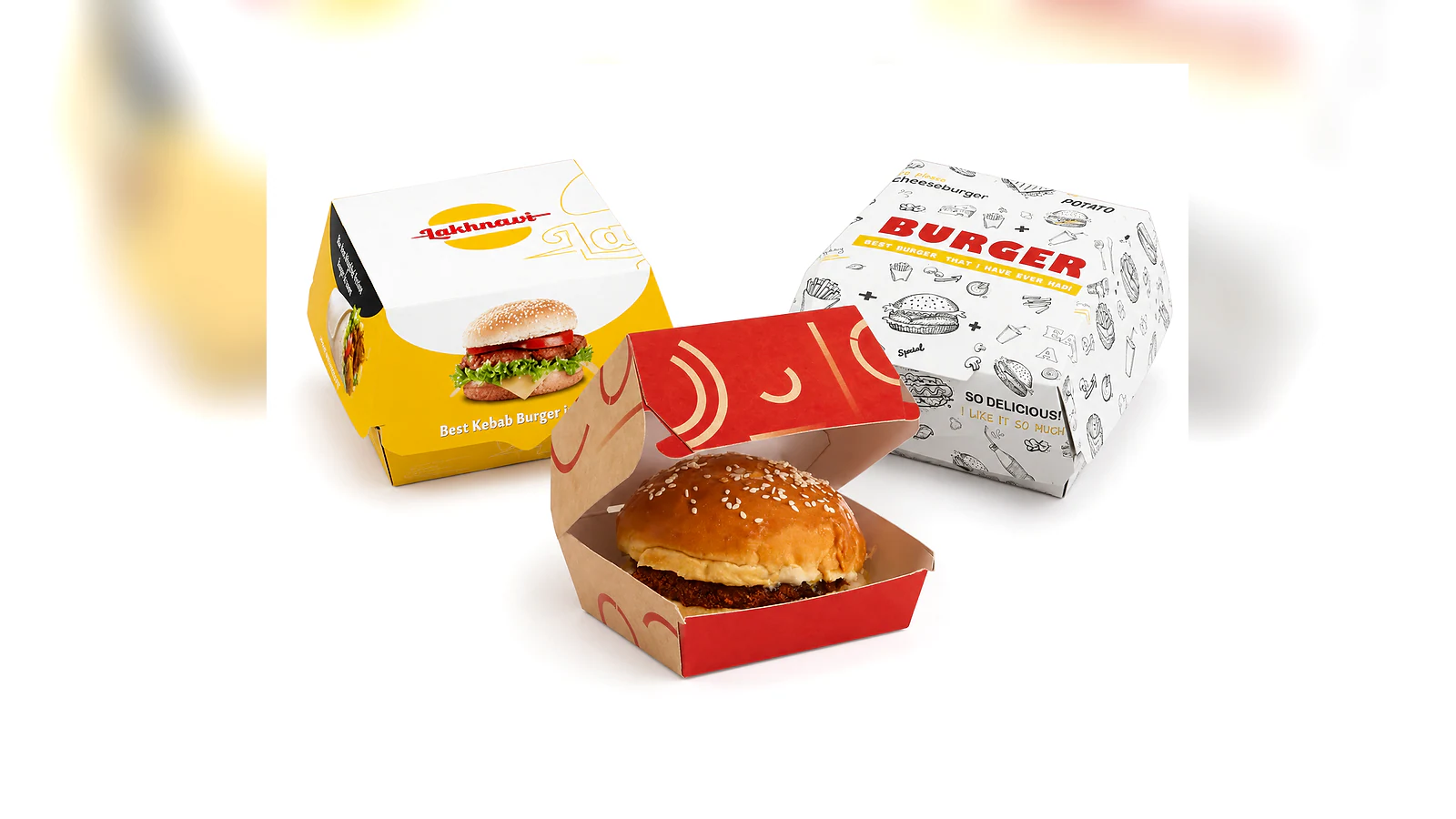
Custom printed burger boxes can protect tall builds and provide strong brand panels, but flat assembly and closed-box volume must suit the truck. Match internal dimensions to the actual burger so the food is not crushed or sliding.
Use the burger delivery route guide for longer journeys and delivery bags. This food-truck guide focuses on station space, service throughput and event stock rather than repeating the route-test protocol.
Use trays for immediate eating occasions
Open hamburger paper trays or broader food trays can reduce closure steps for customers eating nearby. Test tray depth, liner, grease, wind, hand stability and whether the venue provides tables.
An open tray may need an outer bag or lid for longer carrying. Do not assume the fastest counter format is suitable for every customer route. Define which order types receive a tray and which receive a closed box.
Match specialty formats to the menu
Hot dogs, tacos, fried snacks and bowls behave differently. Compare hot dog trays and taco boxes when shape and topping support matter instead of forcing those foods into a burger carton.
Specialty formats earn their shelf space only if they improve speed, presentation or failure rate enough to justify another SKU. Test the benefit with the real menu and include the item in the load and reorder plan.
Use wraps to save space without hiding costs
Greaseproof wrapping paper stores compactly and can serve burgers, sandwiches and bakery items. The correct sheet size, barrier, fold pattern and print orientation affect both food performance and staff time.
Measure sheets wasted through double picks, tears and incorrect folds. Include stickers or labels, dispenser space and the time to identify orders. Compact material is not automatically low cost when labor or errors increase.
Plan bags by complete order footprint
A kraft takeaway paper bag should fit the actual mix of boxes, trays, cups and sauces without excessive empty space or crushed handles. Test the base dimensions, paper strength, closure, carrying distance and customer grip.
Use more than one bag size only when the volume difference creates a clear operational benefit. Store bags where staff can open them without blocking food assembly, and keep handles from tangling during rapid picks.
Control cups, lids and drink carriers
Drinks introduce lid matching, condensation and spill risk. Limit cup and lid series where the beverage menu permits, and mark stacks so staff do not force the wrong lid during a rush. Test the filled drink through the customer carry route.
Compare clear cold cups, paper cups and carriers within the full order. Keep drink storage and packing separate from hot-food packaging where the workstation and food-safety plan require it.
Protect packaging from outdoor conditions
Wind can lift open trays, wraps and napkins. Humidity can soften exposed paper, while rain can damage reserve cartons during loading. Define covered storage, dispensers, weights or lids appropriate to the service environment.
Run a setup test at the actual stall or service window. Check how customers receive the order in wind, whether loose labels adhere and whether packaging touches wet counters. An event plan should include weather-related alternatives.
Forecast event packaging from servings
Start with expected servings by menu item and service window. Multiply each item by its package consumption, then add components such as bags, sauce cups, liners and labels. Use past sales and event-specific uncertainty to set a documented buffer.
Do not apply one percentage blindly to every SKU. The core burger box may need a different buffer from a rarely selected specialty tray. Include staff meals, samples, remakes, damaged units and packaging used during setup.
Create an event load sheet
- Forecast: estimate menu quantities by hour or service block.
- Convert: calculate packaging units for each sellable item and component.
- Count: verify usable opening stock and reserve stock by SKU.
- Load: assign cartons and bundles to truck, trailer, support vehicle or venue storage.
- Replenish: define trigger levels, runner, access route and backup source.
- Reconcile: record ending stock, waste, shortages and next-event adjustment.
Set replenishment triggers before service
Define the minimum working bundle that triggers a refill and the reserve level that triggers a purchase order. Assign responsibility. During a rush, “someone will notice” is not an inventory method.
Use simple visual levels, labeled bins or a count sheet. Keep a controlled emergency alternative for critical SKUs, but test it with the menu and make sure staff can distinguish it from the approved package.
Plan commissary and support-vehicle stock
A commissary or support vehicle can extend capacity, but access time matters. Record the travel or walking time, who leaves the service station, and whether cases remain protected and dry. High-value truck space should carry the next service block, not every future event.
Label cases on more than one visible side with SKU, size, artwork revision and quantity. Load first-needed packaging last or in an accessible zone so event setup does not require unloading the entire vehicle.
Control order accuracy with visible cues
Use size marks, product names, color bands, labels or ticket positions that remain visible after closing. Avoid relying on staff memory when several boxes look alike. Order identification should not cover vents, food-contact areas or essential brand information.
Run a mock queue with similar menu items and modifications. Measure wrong-package picks, reopened boxes and handoff confusion. Fix the cue before mass printing artwork.
Manage allergen and ingredient communication
Packaging does not replace the operation’s allergen and food-safety controls. Decide where approved ingredient, allergen, order-modification or customer-name information appears and how staff prevent label or package mix-ups in the limited workspace.
Keep label templates controlled and readable under outdoor lighting. If several customers wait together, make the handoff identifier visible without exposing unnecessary personal information.
Keep food-contact review item-specific
Request evidence for the exact finished package, including paper or fiber, coating, adhesive, ink position and intended food, time and temperature conditions in the destination market. A generic material statement is not enough for the printed and converted item.
Use the food-contact packaging checklist to link documents to the supplier SKU and revision. Packaging performance does not establish safe food temperatures; the operator must follow its current food-safety plan and local rules.
Test heat, grease and moisture by service route
For immediate handoff, test the time from filling to the customer eating nearby. For takeaway or event catering, include the actual walking or transport interval. Inspect leakage, softening, steam, closure, hand comfort and food presentation.
Use the same food load and timing for every candidate. Record failures at the first observed time instead of only at the end, so material, barrier and format changes can be compared meaningfully.
Make disposal instructions match each venue
An event may provide recycling, commercial compost collection, landfill-only waste or a mixed system. Confirm what the organizer and local collector accept before printing or displaying an instruction. Food residue and mixed materials can change the route.
Use the sustainable burger box buyer guide for claim evidence and qualification. Do not call every brown fiber package recyclable, compostable or biodegradable by appearance.
Choose custom print or flexible branding
Custom printing creates consistent brand visibility and can remove a labeling step, but it requires artwork control, MOQ, production lead time and stock commitment. Stickers, stamps or sleeves can support pilots, seasonal menus and early demand uncertainty.
Compare cost per served order, not only print price. Include label labor, misapplication, unused seasonal inventory and the marketing value of consistent packaging. Approve structure before final artwork so folds and locks do not hide essential elements.
Build an event and daily volume model
Normal route
Average daily menu mix, working stock, weekly consumption and regular reorder point.
Event route
Attendance scenario, service window, menu limit, buffer, support stock and post-event remainder.
Growth route
Additional trucks, shared artwork, SKU standardization, warehouse space and forecast by location.
Compare MOQ with storage and demand
Ask for the minimum order quantity for each exact size, material and artwork. A low unit price is not useful if the truck or commissary cannot store the stock or if a seasonal design becomes obsolete before use.
Model monthly consumption, event peaks, shelf life of artwork, carton count and reorder lead time. Confirm whether several designs or sizes can share a production run without losing item identification and quality control.
Schedule samples, artwork and first production
Use existing samples to screen formats, plain custom samples to verify dimensions and workflow, printed proofs to approve brand placement, and pilot production units for repeatability. State what each sample can and cannot prove.
Work backward from the first event date through specification, samples, revisions, artwork, tooling, production, inspection, freight, customs and local delivery. Leave contingency for a failed workstation or menu test.
Calculate landed and operating cost
Include unit price, tooling, cartons, freight, duty, inspection, storage and damaged stock. Add staff assembly time, labels, liners, double packaging, cleanup, remakes and sales lost when a SKU runs out.
Flat cartons may reduce freight and storage while adding assembly time. Nested containers may accelerate service while using more cube. Compare the complete system by cost per successfully served order and peak capacity.
Set incoming QC for mobile operations
Inspect dimensions, weight or caliper, crease, locks, glue, rim, denesting, barrier, odor, print, pack count and carton condition. Include a short real-food or workflow check for features critical to the truck.
Trace cases to item code, artwork revision, lot and production date. Require advance notification of changes to material, coating, ink, adhesive, die, forming, facility or subcontractor that may alter performance or approved claims.
Audit shortages and waste after every event
Record opening stock, added stock, sales, remakes, damaged packaging and closing stock. Reconcile differences while the event is fresh. A shortage can indicate forecast error, uncontrolled staff use, wrong case count or an unexpectedly popular item.
Review unused specialty packaging and decide whether to change the menu, buffer or SKU. Continuous reconciliation turns event experience into better purchasing rather than repeating the same emergency order.
Use commercial pages for the next sourcing step
The fast food packaging solution organizes the broader product range. Cloud kitchen and catering packaging supports commissary, events and central production, while takeaway packaging solutions cover a wider restaurant system.
This guide should remain focused on mobile-space and event-stock decisions. Product pages carry dimensions and quotations; the delivery guide carries route performance; the sustainable guide carries material and disposal evidence.
Send a complete food truck packaging RFQ
- Truck, trailer, cart, pop-up or event service model
- Menu item, portion, temperature, grease, moisture and service route
- Primary package and approved alternative for each menu item
- Workstation, shelf, cabinet and dispenser dimensions
- Flat, nested or pre-erected preference and inner-pack limits
- Normal daily volume, peak throughput and event scenarios
- Working stock, reserve stock and replenishment method
- Material, barrier, closure, vent, liner, lid and carry-bag needs
- Print, label, size cues and artwork versions
- Destination-market food-contact documents and venue disposal rules
- Samples, MOQ, tooling, lead time, carton dimensions and shipping term
- Incoming QC, traceability, change control and first event date
Frequently asked questions
What packaging does a food truck need?
Build the list from the actual menu and service route. Common groups include open food trays, burger or sandwich boxes, wraps, lidded containers, sauce cups, drink cups and lids, carry bags, napkins and labels. Reduce duplicate sizes where performance and workflow allow.
How can a food truck store packaging in limited space?
Compare flat, nested and pre-erected formats by usable units per shelf or cabinet, not only units per case. Measure carton and bundle dimensions, define the working quantity at each station, and keep sealed reserve stock in a dry protected location.
Should food trucks use custom printed boxes or stickers?
Custom print can reduce labeling steps and strengthen consistency at sufficient volume. Stickers or stamps can suit pilots, rotating menus and small event quantities. Compare artwork control, labor, storage, MOQ, lead time and cost per successfully served order.
How much packaging should a food truck take to an event?
Forecast servings by menu item and service window, convert them to packaging SKUs, add a documented buffer based on uncertainty and past waste, then subtract usable opening stock. Include packaging consumed by staff meals, samples, remakes and damaged units.
What packaging is fastest during a food truck rush?
The fastest format is one that staff can identify, pick, open, fill, close and hand off correctly in the real workstation. Run a timed peak simulation comparing flat cartons, nested clamshells, trays and wraps while recording errors, double picks and counter congestion.
How should food truck packaging handle burgers and fries?
Treat the menu components separately. Burgers need controlled fit, grease and steam performance; fries often need greater moisture release. Test trays, wraps, vented boxes or separated compartments rather than sealing both items together by default.
What belongs in a wholesale food truck packaging RFQ?
Provide the menu and portions, food conditions, package formats and dimensions, workstation and storage limits, daily and event volumes, print, food-contact documents, disposal requirements, samples, quantity by SKU, destination, lead time and replenishment plan.
Design the packaging system around the mobile kitchen
Effective food truck packaging protects the menu while fitting the physical operation. The buyer should be able to state where every SKU sits, how many units fit, how quickly staff use it, when stock is replenished and what happens at an event peak.
Build the menu matrix, measure the station, test peak throughput, forecast events and purchase against real storage and lead time. That creates a stronger custom-packaging brief than a list of attractive boxes.
Need a food truck packaging range and event-stock plan?
Send the menu, portion sizes, truck or stall layout, shelf limits, normal and peak orders, event forecast, package formats, print, quantity, destination and launch date. GLY PACKAGING can organize product options, samples, commercial terms and QC questions.
Request a Food Truck Packaging ReviewSend the Menu and Stock Plan