Molded Fiber Sourcing Guide
Bagasse Food Packaging: Buyer’s Performance & End-of-Life Guide
Bagasse can be a strong foodservice option, but the material name does not define the finished package. Buyers need to test the exact geometry, fiber weight, barrier system, closure, food load, service route and end-of-life claim before approving production.
What bagasse food packaging is
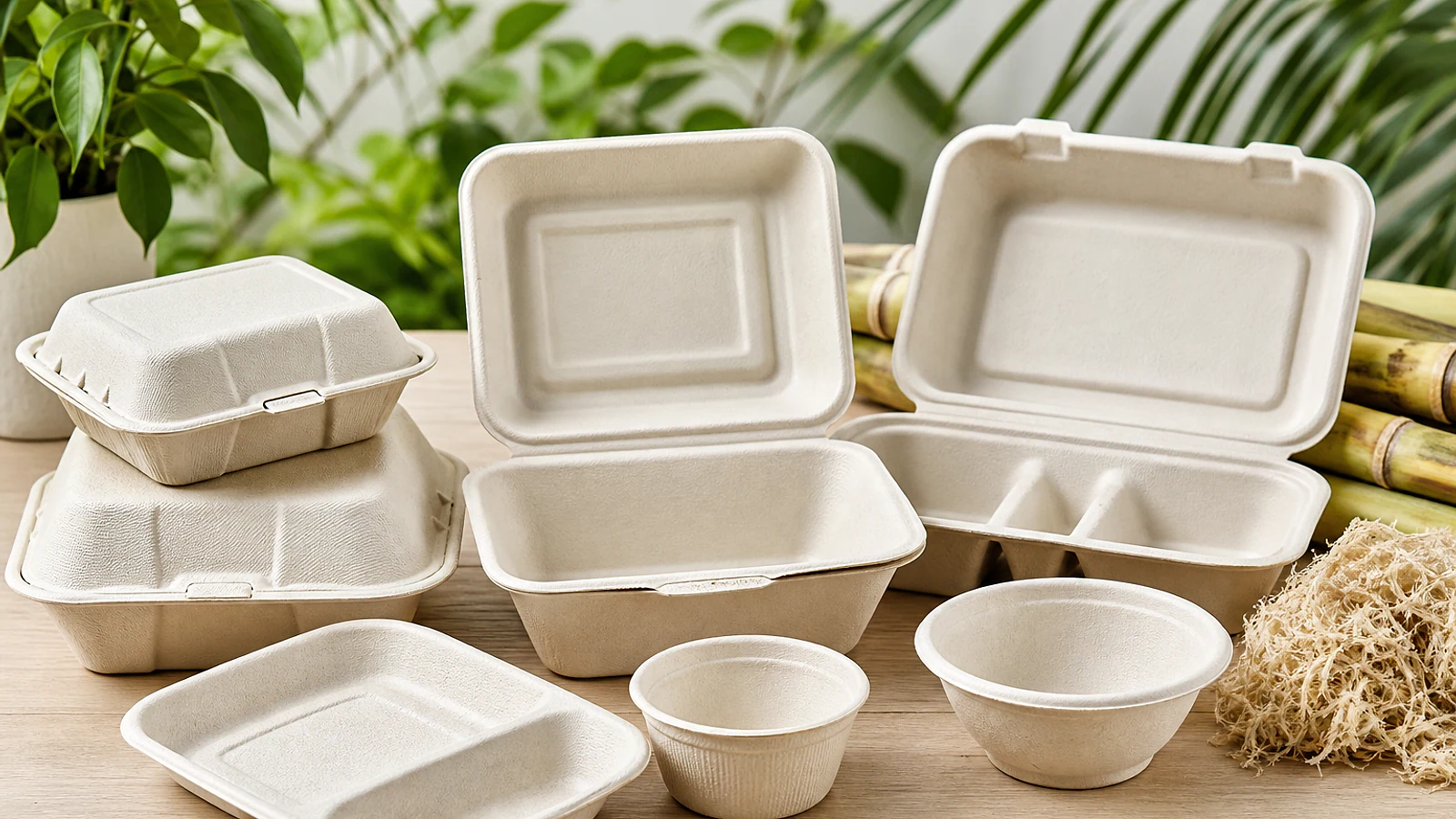
Bagasse is the fibrous material remaining after juice is extracted from sugarcane. Packaging manufacturers can combine prepared fiber with water, form it in molds, press and dry it into plates, trays, cups, bowls or hinged boxes. That common origin does not make all finished products equivalent. Fiber preparation, recipe, forming pressure, drying, wall distribution and surface treatment can produce noticeably different strength and appearance.
Buyers often use bagasse as a broad purchasing label for molded plant-fiber packaging. The useful specification must go further. It should name the exact finished dimensions, product weight, cavity volume, compartments, rim or hinge design, barrier construction, color, tolerances and application. This prevents a quotation from being compared only by the material word and unit price.
Benefits that matter in a real foodservice operation
Rigid molded shapes
Molded walls, ribs and rims can support meals that need more structure than a thin wrap. Shape design can separate food, improve handling and create a stable presentation.
Fiber-based appearance
Natural or white molded fiber can communicate a material change visibly. The appearance still needs controlled color, surface and mark specifications for a repeatable brand result.
Potential compostability route
Eligible finished items may support a defined compostability program when the exact SKU, full construction, certification and local collection route are verified.
These advantages are conditional rather than automatic. A tray that works for dry bakery items may fail under hot curry, and a deep clamshell that protects a burger may trap steam around fried food. A useful sourcing decision connects each benefit to a menu, service time and acceptance test.
Limits buyers should discover before a purchase order
Molded fiber can soften, wick, stain, warp or lose closure force when the food and route exceed the designed conditions. Surface texture and color can vary more visibly than on coated paperboard or plastic. Nesting can create denesting problems at the counter, while deep stacks and long transport can add compression damage.
Environmental language can also create risk. Fiber origin does not prove that a coating, ink, adhesive or label is compostable, and commercial compostability does not prove home compostability or collection in every city. Performance claims and end-of-life claims therefore need separate evidence.
Match the format to the menu instead of the trend
| Food and route | Primary risks | What to test |
|---|---|---|
| Dry snacks, bakery and fruit | Abrasion, crumbs, staining and presentation | Surface cleanliness, fiber transfer, stack stability and customer handling |
| Burgers and fried foods | Grease, steam, loss of crispness and latch opening | Ventilation, grease marks, closure after stacking and delivery-bag humidity |
| Sauced meals and curries | Leakage, edge wicking, soft base and flavor carryover | Real sauce, hottest fill temperature, longest hold time and tilt test |
| Cold salads and fruit | Condensation, rim distortion, lid fit and chilled storage | Refrigeration cycle, condensation, stacking and transparent-lid compatibility |
| Frozen or reheated meals | Embrittlement, ice, warpage and unsupported heating claims | Freeze-thaw route and the exact reheating conditions supported for the SKU |
A mixed menu may need more than one construction. Use bagasse food boxes for enclosed meals, bagasse food trays for open service, bagasse cups for portion formats and bagasse plates for immediate consumption. Compare them against paper takeaway containers when print area, folded geometry or another barrier system better fits the project.
Specify capacity by food load, not only fluid ounces
Nominal capacity does not describe how a real meal sits in the package. Rice, noodles, salad, chicken and sauce have different bulk density and shapes. A brimful liquid measurement can overstate the usable food capacity because the operator needs headspace for closing, carrying and mixing.
Send the target portion weight and a photograph or drawing of the plated food. Define usable fill line, compartment allocation and headspace. During sampling, weigh the loaded package and confirm that the lid closes without compressing toppings or pushing sauce toward the rim.
Control dimensions, fiber weight and wall distribution
A drawing should include outside length and width, cavity size, depth, rim width, hinge or latch geometry and stacking features. Add product weight and agreed tolerances. Average weight alone is insufficient if fiber gathers in one region and leaves another wall thin.
Inspect corners, hinge lines, compartment dividers and the base because these areas often reveal forming or handling variation. Record thickness or density measurements where they are meaningful for the design, but judge them together with loaded compression, leakage and closure performance rather than using one number as a quality shortcut.
Evaluate surface, color and odor as specifications
Natural fiber color may vary with raw material and processing. White products add another appearance decision. Establish approved samples for color range, dark specks, pinholes, edge fiber, wrinkles, deformation and surface roughness. Decide which features are functional defects and which are acceptable characteristics of molded fiber.
Open a sealed carton after storage and evaluate odor before food is added. Then conduct a sensory check with a neutral and a strongly flavored menu item. Packaging should not introduce an objectionable smell, taste or loose fiber under the intended conditions.
Do not assume the barrier construction
Oil and water resistance can come from the fiber recipe, processing aids, surface treatment, coating or a combination. Ask the supplier to disclose the complete finished construction and the function of each added component. If a claim such as plastic-free, uncoated or PFAS-free matters, write the claim and evidence requirement into the specification.
The United States market has changed for PFAS-containing grease-proofing agents used on paper and paperboard food packaging. That policy context does not justify guessing about an individual product. Request current destination-market documentation and testing that corresponds to the exact item, formulation and production route.
Build a grease test around the actual food
Standard screening methods can help compare samples, but kitchen reality is more persuasive for approval. Use the real cooking oil, fat level, sauce and serving temperature. Load at normal portion weight, place the container on clean absorbent paper and inspect the base, corners, hinge and closure at defined intervals.
Score visible staining separately from leakage and structural softening. A cosmetic shadow may be acceptable for one brand but not another. Photograph both the food-contact and outer surfaces at 15, 30, 60 and the maximum delivery minutes so that suppliers can reproduce a failure.
Test water, sauce and acidic foods separately
Water resistance does not prove resistance to oily, salty or acidic recipes. Tomato sauces, dressings, pickles, citrus, curries and broths can challenge different parts of the construction. Test each representative food family rather than choosing only warm water.
Use the highest realistic fill temperature and include a tilt or carry simulation. Check edge wicking, divider seepage, rim deformation and whether liquid reaches a latch. When several menu items share one compartmented tray, test migration between compartments as well as leakage outside the package.
Control heat, steam and ventilation
Hot food raises the moisture load inside a closed container. Steam can soften fiber and change the texture of fried foods even when no liquid leaks. Define how long the package remains closed between packing and eating, whether it sits under a heat lamp and whether multiple hot units are stacked.
Vent size and placement are product decisions. Too little ventilation can trap condensation; too much can reduce heat retention or permit spills. Compare vented and unvented samples with the complete delivery bag, seals, napkins and side dishes because the surrounding system affects humidity.
Verify every microwave or reheating claim by exact SKU
Do not convert a supplier’s statement about bagasse as a material into a universal microwave-safe claim. Ask what finished item was evaluated, with which food or simulant, at what power, duration, load and starting temperature, and whether the use is single heating only. Packaging should be used in a microwave only when the package or documented instructions direct that use.
Run an operational trial with the intended food and appliance. Check hot spots, base sag, rim distortion, lid behavior and safe handling immediately after heating. If a separate lid, film, label or utensil is present, confirm whether it must be removed and make the consumer instruction unambiguous.
Test cold storage, condensation and freeze-thaw routes
A package approved only with hot food may behave differently in refrigeration. Cold surfaces collect condensation, and chilled storage can change rim dimensions or lid retention. Place loaded units through the actual preparation, chiller, display and delivery sequence rather than conducting a short empty-cup test.
For frozen meals, define freezing temperature, dwell time, stacking load, thaw method and reheating route. Inspect for cracks, delamination, warpage and ice-related staining. Supplier evidence should match the complete route; freezer suitable and microwave suitable are separate questions.
Make lid fit and closure retention measurable
A lid must match the rim after loading, heating, chilling and transport, not only on an empty room-temperature sample. Define the exact lid SKU and material. Check seating force, corner engagement, hinge memory, latch sound or feel, reopening and visible gaps.
Use a repeatable closure test across multiple cavities or production lots. Turn the loaded package through controlled angles above an inspection surface, then stack it in the normal delivery orientation. Record whether the lid lifts when another container presses the walls or when the delivery bag flexes.
Include stacking and compression in approval
Warehouse cartons, kitchen stacks and loaded delivery bags apply different forces. A package can pass a single-unit leak test but collapse when three hot meals are stacked. Define the maximum number of loaded units, their weight, stacking duration and expected transport vibration.
Inspect base rocking, rim crushing, lid transfer marks and lower-unit deformation. If a delivery platform uses insulated bags, repeat the test inside that bag because retained heat and humidity may weaken the lower containers faster than an open-bench test.
Check nesting and denesting at service speed
Tight nesting saves carton volume but can slow a busy counter when units stick together. Loose nesting can waste space or allow movement that damages rims. Measure stack height and pack count, then ask operators to separate units while wearing their normal gloves.
Time the task and note double picks, torn edges and packages that deform during separation. A small unit-price saving can disappear if staff repeatedly stop to separate cups or trays. Denesting belongs in total-use cost, not only in visual quality control.
Review food-contact evidence for the destination market
Ask for a declaration or supporting records that identify the finished product, material components, intended food types, temperature and conditions of use. The document should correspond to the market where the package will be sold. A generic raw-material certificate should not be represented as evidence for every finished construction.
Connect this review with the broader food-contact packaging document checklist. Keep the approved supplier, item code, revision, artwork, barrier description and supporting records in one controlled file so that purchasing and quality teams refer to the same product.
Verify compostability as a product claim
Compostability certification applies to an exact item and defined scope. For natural-fiber products, maximum grammage can matter in disintegration assessment. Coatings, inks, adhesives, labels and attachments can also affect the certified construction. Use the BPI compostable certification buyer guide to match the supplier, brand, SKU, scope and current catalog evidence.
Commercial Only and Commercial & Home are not interchangeable. Do not tell customers to home compost a product unless the exact item has the appropriate evidence and the disposal instruction is permitted. Avoid broad biodegradable language that gives no environment, conditions or verification route.
Confirm local collection before printing disposal instructions
A certified compostable item may still be refused by a local collection program or processing facility. Acceptance depends on local operations, contamination policy and the items the facility is prepared to handle. Map the intended customer’s real route before choosing the claim and on-pack instruction.
If the market lacks an organics collection route, say so internally and compare other packaging systems without pretending that material alone creates recovery. The sustainable food packaging materials page helps teams choose around the actual disposal infrastructure as well as functional needs.
Compare branding methods without weakening the package
Molded embossing, debossing, labels, sleeves, stamps and printed outer packaging create different visual and operational results. Ask how the method changes tooling, unit cost, MOQ, lead time, barrier construction, food-contact position and compostability scope. A decorative component can become the part that complicates the environmental claim.
For a broader branded range, coordinate the bagasse item with the food brand custom packaging program. Use controlled artwork files and define placement tolerances, contrast, scannability and orientation. Test labels and sleeves through condensation, heat and delivery handling.
Run samples through a five-stage approval plan
- Specification sample: confirm drawing, weight, cavity, rim, lid, surface, color and complete construction before menu testing.
- Food challenge: load representative dry, greasy, wet, acidic, hot and cold foods at the defined portion and temperature.
- Route simulation: hold, stack, carry, chill, freeze or reheat exactly as the operation requires, including the real delivery bag.
- Operator trial: test denesting, filling, closing, labeling and handoff during a realistic service period with normal gloves and tools.
- Production confirmation: compare mass-production units with the approved sample and verify documents, lot traceability and change control.
Use a signed scorecard with measurable pass limits. Separate critical failures such as leakage or unsafe closure from appearance observations. This gives the supplier a clear corrective target and prevents subjective approval from changing between departments.
Define incoming quality control before shipment
An inspection plan can include product weight, dimensions, pack count, stack height, color range, odor, edge finish, pinholes, warpage, closure fit and a short functional challenge. Choose sampling levels and defect classes according to the order and business risk. Keep retained samples from approved and shipped lots.
Trace cartons to the supplier item, buyer code, production date or lot and quantity. Require notification before changes to fiber source, formulation, barrier, tooling, forming line, facility or subcontractor. A change that seems small can alter food performance or the evidence supporting a claim.
Diagnose common bagasse packaging failures
| Observed failure | Likely questions | Next test |
|---|---|---|
| Base becomes soft | Food temperature, sauce, oil, hold time, wall distribution and barrier | Timed loaded test with photos and weight-controlled portions |
| Lid opens in transit | Rim tolerance, latch geometry, heat deformation and stacking pressure | Closure-force comparison before and after hot stacking |
| Fried food loses crispness | Steam load, venting, bag humidity and travel time | Vented versus unvented delivery-bag trial |
| Units stick in a stack | Nesting taper, surface moisture, deformation and packing pressure | Operator denesting time across multiple cartons |
| Grease marks vary by lot | Fiber recipe, barrier application, weight variation and process change | Retained-sample comparison with the same oil challenge |
| Environmental claim cannot be proven | Wrong SKU, missing component, expired evidence or unsupported scope | Full construction and current certification-record review |
Send a failure report that identifies SKU, lot, food, load, temperature, timeline and photographs. Avoid statements such as weak material or bad coating without the conditions. Reproducible information shortens root-cause work and protects the next trial from repeating the same uncertainty.
Compare MOQ, tooling and landed cost
Standard shapes may offer lower tooling exposure and faster sampling, while custom cavities, compartments, embossing or special lids can require new molds and higher minimums. Separate tooling, pre-production samples, certification or testing, unit price, labels, cartons and freight in the quotation.
Calculate usable cost rather than purchase price alone. Include carton cube, warehouse space, denesting labor, damaged rims, leakage credits, extra secondary packaging and the number of sizes needed. A slightly heavier unit can be economical if it reduces failures, while over-specification can add freight and material without improving the route.
Send an RFQ that suppliers can answer accurately
- Food type, portion weight, sauce, oil and acidity
- Fill temperature, hold time, heat-lamp time and delivery duration
- Cold storage, freezing, thawing or reheating requirements
- Usable capacity, dimensions, compartments, headspace and closure
- Target product weight, tolerances, surface and color range
- Full fiber, treatment, coating, ink, label and adhesive construction
- Microwave, freezer and food-contact evidence for the exact SKU
- Compostability scope, current catalog record and local disposal route
- Branding method, artwork, tooling and sample stages
- Quantity by size, destination, carton pack and pallet requirements
- Incoming QC tests, defect limits, traceability and change control
- Target launch date and required production lead time
This information turns a material inquiry into a comparable project. It allows suppliers to identify where a standard item is suitable and where a custom design or different construction is necessary.
Frequently asked questions
Is all bagasse food packaging microwave safe?
No. Microwave suitability belongs to the exact finished SKU and its documented conditions, not to the word bagasse by itself. Ask for the time, power, food load, temperature and use limitations covered by the supplier’s evidence, then test the actual packed food.
Does bagasse packaging resist oil and water without a coating?
Performance varies with fiber recipe, forming, density, surface treatment, coating and food conditions. Specify the oil, sauce, acidity, starting temperature and hold time, and require the supplier to disclose the complete construction rather than accepting a generic material claim.
Can a bagasse container go into a home compost bin?
Do not assume so. Commercial compostability and home compostability are different scopes. Verify the exact SKU and certification, and confirm what the local collection program or compost facility accepts before giving disposal instructions.
How should a buyer test a bagasse clamshell?
Load the real menu item at its normal serving temperature, close it with the intended liner or cutlery, hold it for the longest realistic delivery time, stack it in the delivery bag and check leakage, softening, lid fit, latch retention, odor and customer opening.
What affects the price of custom bagasse packaging?
Size, cavity depth, compartment geometry, fiber weight, forming cycle, surface finish, barrier system, lid design, tooling, print or label method, carton pack, certification scope, order quantity and destination all affect the commercial result.
What documents should accompany a bagasse food packaging quote?
Request the full construction, food-contact evidence for the destination market, product drawing, weight and dimensional tolerances, barrier details, microwave or freezer evidence where claimed, compostability records for the exact SKU, QC plan and change-control commitment.
What is the fastest way to compare two bagasse samples?
Use the same food load, temperature, hold time, transport route and scoring sheet for both samples. Record weight, dimensions, closure force, leakage, rim distortion, stacking damage, denesting and odor so that the choice is based on repeatable evidence.
Choose bagasse by evidence, not assumption
A reliable bagasse project connects the menu, temperature, hold time, geometry, fiber distribution, barrier, closure, operational test, documents and disposal route. The material can then be evaluated for what it actually does in the buyer’s system instead of carrying promises that belong to another product.
This guide is a purchasing framework rather than legal, certification or food-safety approval. Requirements and certification programs change. Confirm current destination-market rules, official program records and local facility acceptance before printing claims or launching the finished package.
Need a bagasse packaging sample and specification review?
Send the food, serving temperature, portion, hold time, target format, quantity, destination, branding and end-of-life requirement. GLY PACKAGING can organize the SKU options, sample plan, commercial quotation and quality questions around the real service route.