Cold Cup Closure Buyer Guide
Dome, Flat & Sipper Lids for Cold Cups: Buyer’s Fit Guide
A lid style is only useful when it fits the exact rim and protects the real drink. This guide turns dome, flat and sipper options into a cup-lid matrix, sample test and RFQ that a buyer can verify.
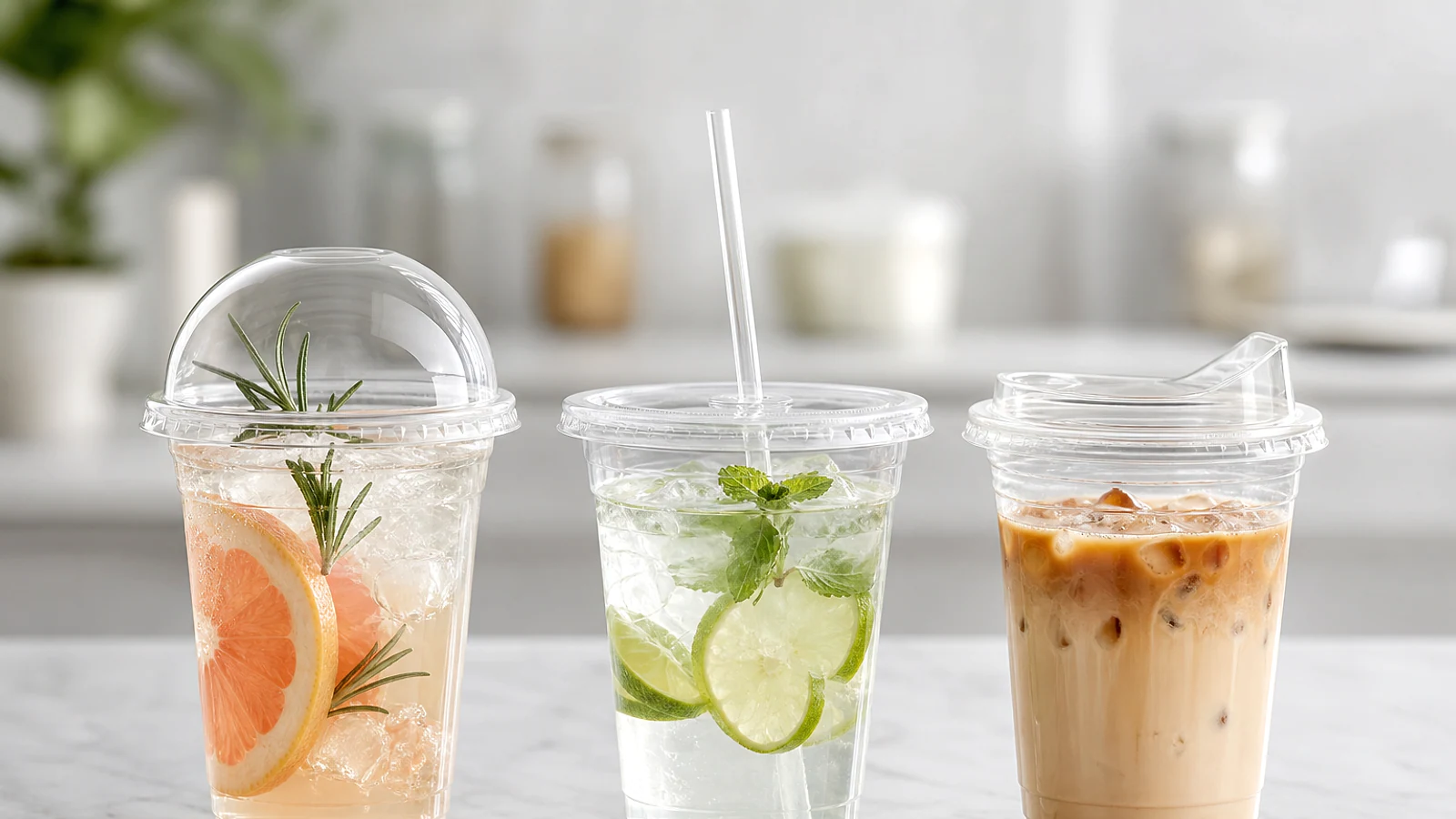
Dome vs flat vs sipper lids: quick comparison
| Lid format | Best starting use | Critical questions | Common mistake |
|---|---|---|---|
| Flat lid | Cold drinks with controlled headspace; straw-slot or no-hole service | Does the straw slot match the straw, and does ice contact the underside? | Filling too high or assuming every flat lid has the same opening |
| Dome lid | Whipped cream, cold foam, fruit, ice cream or decorative toppings | Is dome height and width sufficient after normal handling? | Choosing by appearance without measuring the topping envelope |
| Sipper lid | Strawless iced coffee, tea and other drinks intended for direct sipping | Is flow, venting, lip comfort and splash control acceptable? | Testing with water instead of the actual recipe, ice and foam |
Start with the finished drink, not the lid catalog
Record every drink recipe, service temperature, ice format, foam, fruit, pearls, whipped cream and expected hold time. Also record whether customers drink through a straw, sip directly, use a spoon or remove the lid. These inputs determine the opening and clearance before material or color is discussed.
Map each recipe to its usable fill line and service route. A counter-served soda, a sealed delivery iced coffee and a boba drink in a tall narrow cup expose the lid to different movement and customer actions. The boba cup geometry guide helps explain why cup profile and topping load belong in the same decision.
Flat lids: low profile with controlled headspace
A flat lid keeps the packed drink height low and can suit iced tea, juice, soda and coffee when the recipe remains below the rim. Variants may have an X-slot, round straw opening, sip opening or no opening. State the exact feature in the item description because “flat lid” alone does not define how the customer drinks.
Check the underside against ice cubes and the fill line. If ice presses continuously on the lid, normal walking movement may open a local gap or push liquid toward the slot. Measure carrier and bag height as well; a lower profile can improve packing density only when the complete set remains stable.
Dome lids: reserve verified space for toppings
Dome lids provide vertical volume above the cup rim. That volume can protect whipped cream, cold foam, soft serve, fruit or decorative toppings, but dome height is not usable unless its internal width also clears the product. Measure the finished topping envelope rather than relying on a photograph.
Choose a straw hole, spoon access or no-hole design according to service. Test whether the dome traps product where it becomes difficult to consume, whether toppings touch the opening during transport and whether the higher lid changes carton, carrier or delivery-bag clearance.
Sipper lids: direct drinking changes flow and venting
A strawless sipper lid can simplify the drinking action, but it changes the relationship between aperture, vent, headspace and ice. Flow that feels comfortable with water may splash with coffee, clog with foam or allow small ice pieces to obstruct the opening. Use every high-volume recipe during approval.
Inspect the lip-contact edge, opening position and any raised drinking deck. Confirm that staff can orient and apply the lid consistently. If the lid includes a plug, tab or reclosure feature, test it after repeated opening and normal condensation rather than judging it only in a dry empty sample.
Build a menu-to-lid decision matrix
| Recipe condition | Starting format | Test focus |
|---|---|---|
| No toppings, standard straw service | Flat lid with defined straw opening | Straw insertion, slot tearing, headspace and transport drips |
| Whipped cream or high cold foam | Dome lid | Internal clearance, presentation after movement and opening access |
| Strawless iced coffee or tea | Sipper lid | Flow, venting, lip comfort, ice interference and splash |
| Large fruit, pearls or thick smoothie | Format matched to wide straw or spoon | Opening dimension, topping passage and customer handling |
| Delivery with long hold time | Best-performing tested closure | Application consistency, side load, bag movement and condensation |
This matrix narrows the sample list; it does not replace tests. If one drink appears in several routes, approve it under the longest realistic hold and the most demanding movement. Use the coffee shop packaging solution to align cups, lids, carriers, sleeves and bags around the same service workflow.
Rim compatibility is more than a diameter
A rim has an outside diameter, curl or bead shape, thickness, undercut and local variation around the seam. A lid has a corresponding channel and engagement feature. Two catalogs may print the same nominal millimeter value while the components use different profiles or tolerances.
Request dimensional drawings and named item numbers for both parts. Measure samples at several positions, but use measurements to investigate fit rather than to declare compatibility alone. The final evidence is repeatable application and performance across representative cup and lid lots.
Cup capacity does not identify a lid
A 12 oz, 16 oz or 20 oz cup can belong to different rim families. Conversely, several capacities may intentionally share one rim so a buyer can reduce lid SKUs. Maintain a matrix that lists cup code, capacity, top diameter, lid code, lid format, material, approval date and tested lot.
If the supplier proposes one common lid, test it on every cup size and wall geometry. Do not infer a fit from one size. The coffee cup size planning guide explains why capacity, usable fill and physical dimensions need separate records.
Set headspace from ice, foam and topping movement
Headspace is the distance between the liquid or product and the underside of the lid under service conditions. Ice floats, foam expands and toppings shift when the cup is carried. Set a fill line using the complete recipe, not plain water at room temperature.
Photograph the filled cup from the side before and after the route test. If a dome is used, record both maximum topping height and the clearance that remains after the lid is applied. If a flat or sipper lid is used, check whether ice blocks the vent or pushes liquid toward the opening.
Match straw and spoon access deliberately
Straws differ in outside diameter, stiffness and end shape. A narrow straw may move loosely in a large hole, while a wide paper or boba straw may tear an X-slot or require excessive insertion force. Test the exact straw SKU with the exact lid and ask staff to insert it during a normal service sequence.
For thick drinks or large inclusions, confirm that the opening and utensil allow customers to reach the product without removing the lid unexpectedly. Record whether the opening creates sharp edges, fragments or unacceptable resistance after repeated insertions.
Check sip flow, air return and splash behavior
Direct sipping requires liquid to leave while air returns to the cup. Opening and vent geometry affect flow, gurgling and splash. Test slow and normal drinking angles with a safely cold beverage, and keep the fill level constant between lid options so the comparison is fair.
Inspect how ice approaches both aperture and vent. A design may work when the cup is stationary yet surge after ice temporarily blocks air return. Note whether customers must rotate the lid, whether the drinking deck collects liquid and whether a carrier angle changes the result.
Specify lid material and intended conditions
PET, recycled-content PET, PP, PLA and other materials are not interchangeable labels. They can differ in clarity, stiffness, forming behavior and intended temperature conditions. Ask the supplier to identify the exact material and finished-product use rather than accepting a generic “plastic lid” description.
Cold drink use must still be defined by temperature, food type and contact duration. If recycled content, bio-based content, compostability or recyclability is claimed, request evidence for the exact lid and destination. The paper versus plastic cup guide provides a broader framework for qualifying material and end-of-life claims.
Review food-contact evidence for the assembled set
Collect the available declaration, test or compliance documentation for the exact cup and lid materials, colors and intended conditions. Confirm that the destination market and actual beverage contact are covered. A document for a resin or a different lid model is not automatically evidence for the finished item being purchased.
Printing, labels, colorants and additives may change the specification. Record which side of each component contacts the drink and whether the lid can touch foam, toppings or liquid during transport. Use the food-contact documentation checklist to organize supplier statements, item identities and change control.
Request representative samples, not one perfect pair
Begin with structural samples for every proposed cup-lid pair. Obtain enough components to test repeated application by more than one staff member. When practical, include samples from different production positions or lots so approval is not based on one unusually favorable fit.
Keep approved samples in clean, labeled storage with drawings, photographs and the test sheet. A golden sample is most useful when its item number and production status are traceable. Replace it when the supplier changes a mold, material, gauge or manufacturing route.
Measure application force and seating consistency
Ask several staff members to apply the lid on a stable counter using the intended workflow. The lid should seat around the full circumference without forcing the cup wall to buckle. Mark any location that remains high, especially near a cup seam or local rim irregularity.
Record application problems separately from transport problems. An apparently loose lid may actually be incompletely seated, while a very tight lid can damage cups during a busy shift. Training cannot compensate for a component pair that requires excessive or inconsistent force.
Run a controlled cold-drink leak and handling test
- Identify the parts. Record cup SKU, lid SKU, material, lot or sample reference, straw and carrier.
- Prepare the recipe. Use the normal drink temperature, ice, toppings and target fill line.
- Apply consistently. Seat the lid on a stable surface and inspect the full rim immediately.
- Hold and move. Use the real counter time, walking route, delivery bag and vehicle vibration where relevant.
- Inspect defined points. Check the rim, opening, vent, straw slot, cup seam and any liquid collected on the deck.
- Record pass or revision. Save photographs, elapsed time, staff notes and the exact component identities.
Add the carrier and delivery bag to the test
A lid can remain secure on a counter but fail when neighboring cups touch, a carrier flexes or a bag applies side pressure. Test one-cup, multi-cup and mixed-height orders. Confirm the cup base fits the carrier and that high dome lids do not collide with bag handles or other packages.
Walk and drive the longest realistic route. Include turns, braking, doorways and normal lifting. Inspect whether condensation weakens the carrier, whether the cup tilts and whether the lid catches against the bag. The molded fiber drink carrier page can help define the complete transport set.
Evaluate condensation and cold-hold performance
Condensation can change grip, labels, carton dividers and the way staff handle a lid. Run the test in expected ambient humidity and hold the drink for the real pickup or delivery time. Watch for rim distortion, lid relaxation, fogging, brittleness and changes in application or removal.
If the cafe uses paper cups for some cold drinks, test outer-wall stiffness and print as well as the lid. The large paper cold-cup guide covers ice load and coating questions that should be added to that sample plan.
Diagnose failures before changing the whole system
| Observed failure | Areas to inspect | Next controlled check |
|---|---|---|
| Lid lifts at one point | Incomplete seating, local rim shape, seam area, damaged stack | Mark the location and compare several cups and lids by lot |
| Lid pops during carrying | Loose engagement, side pressure, cup flex, temperature response | Repeat in the intended carrier and isolate the variable |
| Drink escapes at straw slot | High fill, ice impact, straw diameter, slot geometry | Standardize fill and test the actual straw with movement |
| Sipper splashes or gurgles | Vent, aperture, ice, foam, drinking angle | Compare recipes at equal headspace and record flow |
| Dome damages topping | Insufficient internal height or width, product shift | Measure the topping envelope before and after transport |
| Reorder fits differently | Unannounced substitution, mold or gauge change, mixed stock | Quarantine lots and compare against approval records |
Control MOQ, carton ratios and usable sets
Cup and lid minimum order quantities may apply per size, material, color or mold. Their carton quantities can differ. Calculate how many complete drink sets the order creates instead of comparing component totals. Add a justified allowance for application damage and operational loss.
Track consumption by cup-lid pair. A shared rim family can reduce lid inventory, but it can also hide a shortage if one cup size grows faster than expected. Confirm production lead time, separate shipment dates, carton marks, pallet configuration and whether partial replacement cartons are available.
Protect hygiene and identity through packing
Lids should arrive protected from dust, crushing and uncontrolled mixing. Specify inner sleeves or bags, carton quantity, lot identification and storage orientation. Warehouse staff should be able to distinguish flat, dome and sipper items without opening every sleeve.
Keep cartons dry and within the supplier’s stated storage conditions. Do not combine visually similar loose lids in an unmarked bin. At receiving, compare item code, carton label, count, color, visible deformation and fit samples against the approved record.
Use revision control when suppliers or molds change
A material substitution, new forming tool, gauge change or plant transfer can alter fit even when the item name remains unchanged. Require advance notice and identify which changes trigger new samples, food-contact review or full cup-lid testing.
If old and new stock will overlap, test cross-combinations explicitly or separate them physically. Never let staff discover incompatibility during service. A clear revision code on purchase orders, cartons and inspection records makes complaints traceable.
Cold drink cup lid RFQ checklist
- Every cup item code, capacity, material and dimensional drawing
- Top-rim outside diameter plus curl, bead or profile information
- Drink temperature, ice format, foam, fruit, pearls and other toppings
- Usable fill line, headspace and expected counter or delivery time
- Flat, dome or sipper preference and exact opening requirement
- Straw or spoon item, outside diameter and insertion method
- Lid material, color, recycled content or other substantiated claim
- Quantity by cup and lid SKU, carton ratios and forecast by month
- Destination market and required food-contact documentation
- Sample quantities, test sequence, acceptance criteria and change-notice rules
- Carton marks, pallet plan, destination and target arrival date
For a defined clear-cup program, start with the custom PET cold drink cup page. Buyers comparing wider formats can review the cups and bowls range and the separate hot coffee cup-and-lid fit guide.
Frequently asked questions
What is the difference between flat, dome and sipper cold cup lids?
A flat lid keeps the pack profile low and commonly provides a straw slot. A dome lid adds vertical clearance for whipped cream, foam, fruit or other toppings. A sipper or strawless lid lets the customer drink through a shaped opening. Exact features vary, so approve the named lid SKU rather than the style name alone.
Does the same rim diameter guarantee that a lid will fit?
No. Nominal diameter is only a screening value. Curl shape, bead profile, undercut, material stiffness, forming tolerance and batch variation also affect engagement. Test the exact cup and lid SKUs from representative production samples.
Can one lid fit several cold cup sizes?
Yes when those cup sizes are deliberately produced as one verified rim family. Keep a written compatibility matrix and do not assume that equal ounce sizes or similar catalog dimensions make products interchangeable.
When should a cafe choose a dome lid?
Choose a dome lid when the finished recipe needs controlled space above the cup rim for whipped cream, cold foam, fruit, ice cream or decoration. Measure the topping envelope and confirm the dome does not crush the product during normal transport.
How should a strawless sipper lid be tested?
Test drinking flow, venting, headspace, lip comfort, splash behavior, application force and transport with the real recipe. Thick drinks, foam and ice can behave differently from water, so a water-only check is not enough.
Are cold cup lids leak-proof?
A disposable lid should not be treated as a sealed bottle closure. Define a controlled leak-resistance and handling test using the real cup, fill level, drink, temperature, hold time, carrier and movement. Avoid unsafe inversion tests.
What information belongs in a cold cup lid RFQ?
Include every cup SKU, rim drawing, capacity, drink recipe, temperature, ice and toppings, preferred lid style and material, straw or sip opening, quantity by SKU, carton ratios, compliance documents, destination, sample plan and acceptance criteria.
Approve a documented pair, not a generic lid name
Dome, flat and sipper describe the customer-facing format, but the purchasing decision depends on the full system. Define the recipe, headspace, opening, rim family, material, application force, transport test, packing ratio and evidence for claims. Then retain the exact approved cup and lid identities for reorders.
A concise matrix helps operations, purchasing and the supplier work from the same facts. It also makes a later failure easier to isolate: the team can identify whether the issue came from the recipe, fill line, application, cup lot, lid lot, carrier or an unapproved substitution.
Need a cold cup and lid match review?
Send your cup drawings or samples, drink recipes, lid style, straw or sip requirement, quantity and destination. GLY PACKAGING can organize the compatibility questions, sample plan and quotation around complete usable sets.